
.png?width=1920&height=1080&name=WiER%20content%202026%201%20(1).png)
The energy transition is often discussed in terms of infrastructure, investment and policy, but it is also a story about people: who leads, who gets heard, who is supported to grow, and how workplaces make room for different kinds of talent. Ahead of the Women in Energy & Renewables Summit, five speakers share candid reflections on leadership, confidence, visibility and the changes needed to build a stronger, more inclusive energy sector.
Challenging the assumptions that shape leadership
For Tania Palmer, General Manager Generation at Meridian Energy, building better workplaces for women starts with looking beyond formal policies and targets to the everyday assumptions that influence how work is designed and rewarded. “As a single mother who raised my children on my own for 15 years while progressing to an executive role in the energy sector, I’ve experienced first-hand some of the assumptions that still exist,” she says. “There can be a tendency to assume women need a partner at home managing family responsibilities, or no children at all, to succeed in leadership.”
Her challenge to the sector is simple but powerful: respond to those assumptions “with more curiosity”. In practice, that means designing roles, teams and cultures that recognise leadership potential in people with different lives, responsibilities and working patterns. “When we do,” Palmer says, “we create workplaces that are more inclusive, more flexible, and ultimately better for everyone.”
Stepping forward before you feel fully ready
Several speakers point to a familiar leadership barrier: the belief that readiness must come before action. Renée Anderson, Interim CEO of TasNetworks, says one of the biggest hurdles women can face “isn’t necessarily a lack of capability - it’s the story we sometimes tell ourselves about whether we’re ready”.
Several speakers point to a familiar leadership barrier: the belief that readiness must come before action. Renée Anderson, Interim CEO of TasNetworks, says one of the biggest hurdles women can face “isn’t necessarily a lack of capability - it’s the story we sometimes tell ourselves about whether we’re ready”.
“Be willing to have a go, ask questions, make mistakes”
For Anderson, waiting until everything feels certain can become a brake on progress. “Leadership rarely works that way,” she says. “You learn a huge amount by stepping into the opportunity, not by waiting until you feel perfectly qualified for it.” Her advice is to be willing to have a go, ask questions, make mistakes and learn along the way, rather than trying to arrive as the finished product.
Lyn Bowring, Executive Director Consumer, Community and First Peoples’ Energy Transition at DEECA, echoes this point. Drawing on experience in emergency management roles, where decisions must be made quickly and under pressure, she says confidence usually follows action. “More often, you take the step, make the best call you can with the information you have, and build confidence through the experience,” she says. “Waiting until you feel completely ready can mean waiting forever.”
Making contribution visible
Leadership growth is not only about capability; it is also about whether contribution is seen and understood. Cathie Metcalfe, Chief of Staff at Amber Electric, says the hurdle she has watched hold women back most “isn’t confidence. It’s the belief that good work speaks for itself.”
“Strategic visibility matters”
Metcalfe describes years of operating behind the scenes - making strategies land and crises disappear - while her work remained largely invisible. “What changed was reframing self-promotion,” she says. “It isn’t announcing yourself. It’s making your contribution legible to people who weren’t in the room.” Her point is not that women need to be louder, but that strategic visibility matters: “You have to be deliberate about when invisibility serves you, and when it costs you.
“People can’t help you if they don’t know what your goals are”
Bowring sees the same pattern in women who “just get on with the job” rather than talk about what they have achieved. She encourages aspiring leaders to share successes, lessons and ambitions more openly, and to use feedback as a way to recognise their own value. “People can’t help you if they don’t know what your goals are,” she says. Her own “value bank” of positive feedback and kind words is something she still revisits when self-doubt creeps in.
Redesigning the systems, not just the expectations
While individual confidence and visibility matter, Sabiene Heindl, CEO of The Energy Charter, argues that the sector must avoid placing the burden of change solely on women. “Too often we celebrate the women who make it to the top without asking why so many talented women never have the opportunity,” she says. “Individual resilience matters, but it isn’t a substitute for systemic change.”
For Heindl, that means creating leadership pathways that value different styles of leadership, building flexibility into senior roles, and ensuring governance intentionally develops diverse talent. “Lasting change happens when we redesign systems, not just expectations of individuals,” she says. It is a lesson she connects to the Regional Energy Accord, where structures are designed to enable collaboration and shared leadership.
“Women are frequently highly skilled at ruthless prioritisation”
Bowring also reframes the capabilities women often build through competing responsibilities as leadership strengths. “Women are frequently highly skilled at what I describe as ‘ruthless prioritisation’,” she says, particularly when balancing leadership with family and caring commitments. “These are leadership capabilities, and they should be recognised and valued as such.”
Her advice to aspiring leaders brings together many of the themes running through these reflections: “Back yourself.” For women working across energy and renewables, that means recognising their capability, staying curious, investing in relationships, taking opportunities before they feel entirely comfortable and seeing the skills they use every day as the building blocks of leadership.
These are the conversations the energy sector needs more of: practical, honest and energising discussions about career growth, leadership capability, workplace culture and the people needed to deliver Australia’s energy transition.
Continue the conversation
These conversations continue at the Women in Energy & Renewables Summit 2026 on 13–15 October, at Pullman Sydney Hyde Park. Renée, Lyn, Tania, Cathie, Sabiene and other senior leaders across energy and renewables will come together for two days of practical learning, honest discussion and connection.
Back yourself, and join them.
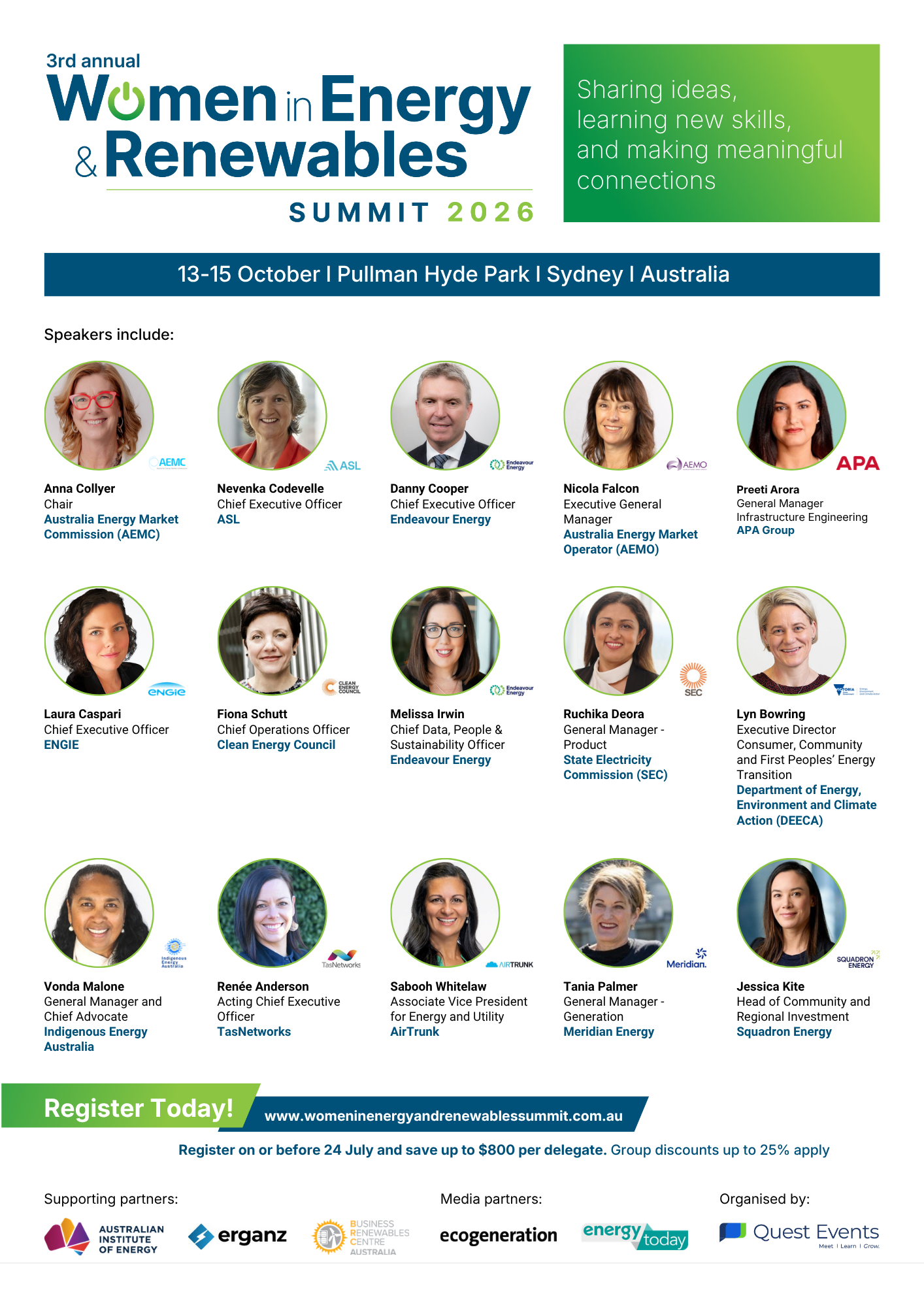
Download the Brochure
Gain insight into what to expect at the 3rd annual Women in Energy & Renewables Summit 2026.